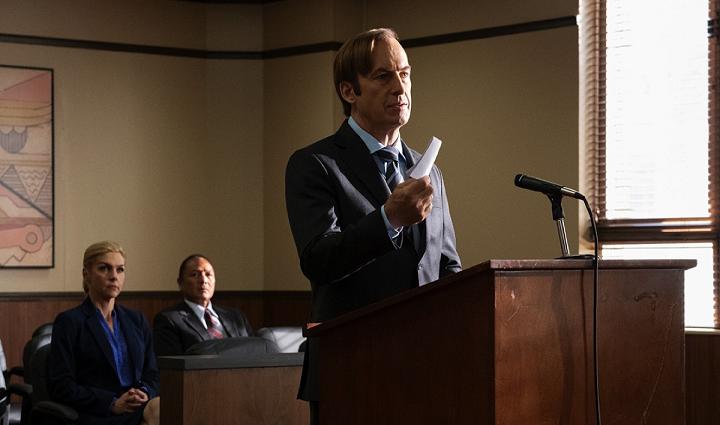
Better Call Saul “The Guy For This” (S5E03)

“It’s not about what you want.  When you’re in, you’re in.” – Nacho

If last episode was about Saul setting events in motion for himself, “The Guy for This” is about him realizing his point of no return. Too many high factors are at play that are beyond his control and will prove more urgent than taking any last chance reservations over his life choices. The prospect of navel-gazing has long passed, being something that might have saved him last season if circumstances with Chuck’s death and their final conversation didn’t drive Jimmy’s decision to avoid therapy. The fun of Jimmy’s reinstatement as the fresh and colorful Saul Goodman stops the moment Nacho scoops him off the street.  The beautifully shot, Blue Velvet-esque cold open plays on these themes of underlying menace with the ants engulfing his discarded ice cream. If there was any shred of innocence remaining in Jimmy, it’s now too late to recover as he’s attracted alien-like adversaries to his happy corner of the world. Jimmy McGill has officially become contaminated and Saul Goodman will soon have no choice but to join the complex inner workings of Better Call Saul’s deep criminal underworld.  A member of the colony, if you will.

This infestation of Jimmy’s soul has been a long time coming.  If it wasn’t for his mix-up with Tuco in the desert, pleading every argument accordingly to prevent Tuco from skinning the skater twins alive, Lalo wouldn’t hold Saul Goodman in such high regard as a “criminial lawyer”.  Jimmy tries to turn away Lalo’s proposition by offering him a drop phone, but is advised that this is business that’s better conducted with a lawyer in person.  Jimmy then tries to increase his rate to a made-up figure of $7,925, suspending disbelief that Lalo and Nacho are no more high profile than his usual clients.  He hopes this expense will repel them but Lalo rounds the offer up to $8,000 with ease and for all we know, was willing to pay Saul more.  If there’s anything Jimmy McGill and Saul Goodman have shared in common since the start, it’s that money is everything.  This is what seals the fate of both counterparts and turns Saul into a greasy cog within the drug game’s machine.  As Saul Goodman in Breaking Bad will later state, “I guess people see those zeroes dance before their eyes… it’s kind of like highway hypnosis.” Jimmy never foretells how he ends up down the path his choices lead, as long as money fills his pockets in the present moment.

Before even getting into what Saul is hired to do here, it’s important to note that Lalo chalking up Jimmy’s talents as the guy with the mouth going “blah blah blah” is a telling sign of disrespect.  He thinks of Saul as a bullshit artist and for the time being, he’s entertained by this superpower, but there’s only so far Saul can spin BS as an attorney and dazzle as a criminal associate before it amounts to some dire consequence.  Jimmy might not consider the repercussions of the shortcuts he takes or the crimes he commits, but he’s pretty aware that this business arrangement is bad news.  Lalo is expecting perfection from Saul like two skater twins walking out of the desert scot-free despite Tuco wanting them dead, but in reality, they got wheeled out of that situation each with a broken leg.  There’s a reality to Saul Goodman’ where there’s always a sorry fallout to his actions and Lalo is unable or refuses to see that.

It gets worse for Saul when he learns he’s assigned to represent Domingo Molina (Krazy 8) and use his client’s ongoing detainment as a way to feed the D.E.A. incriminating information on a third party.  For Saul, this party remains a mystery, but for us, we know the intel of dead drops is in direct conflict with Gus Fring’s operation.  Hector’s ominous idea from last episode to hit Gus where the money flows is now put into play and Saul is caught up as the middleman.  If the intel fails in leading to arrests, then Krazy 8 is going to be locked up and Lalo won’t be a happy customer. If the plan goes off without a hitch, then Saul gets more on Gus’ radar, regardless if we know the two, to Saul’s knowledge, have never met.  There’s really no winning outcome here and as of right now, Nacho informing Gus on Lalo’s plan makes all this double-dealing more transparent and hopefully more manageable.

That’s not to say this isn’t an extremely messy situation.  I would imagine Gus gets the better handle of it and Lalo will become Saul’s true foe, but as of right now the money remains in the places reported to the D.E.A. so as not to raise Lalo’s suspicions of any betrayal.  As a line of communication, Nacho is more valuable to Gus than how much of a hit his operation takes.  That could be seen as a blessing but also a burden since Nacho might continue to be even more of a punching bag depending on how much damage Lalo causes.  Essentially, Krazy 8 is the hotline between the D.E.A. and Lalo while Nacho is the hotline between Lalo and Gus.  Everyone’s connected to a line nobody wants to be a part of.  Even the unwilling Saul Goodman.

Considering it’s Lalo who Saul is most afraid of in Breaking Bad and Fring is more or less a ghost to him, you have to wonder what Lalo is willing to do to ensure he keeps Saul Goodman in line.  Saul tries to excuse himself again from providing any further services by stressing the tightness of his schedule but Lalo doesn’t take no for an answer.  We have seen how far Lalo will go just to get what he wants by tailing Mike, surveilling Gus, and even killing an innocent civilian (TravelWire clerk) outside the game.  He’s intrusive and competent in getting results at any cost.  At what point does Saul throw his hands in the air when what’s asked of him gets too hot? What if Lalo responds by tracking Saul’s residence followed by threatening harm upon Kim? A man like Gus would be wise to avoid tangling with any officer of the court, because he has to maintain the cover life he’s invested so much time building for himself.  Lalo on the other hand, as a Salamanca, is a loose cannon and always has the option to run back home until the heat dies down.

Nacho’s original plan to flee to Canada with his father seems to becoming less and less of an option as Manuel notifies him about his upholstery shop getting a generous buyout offer.  He suspects Nacho put the buyer up to this so Manuel can be in a better position to lam it.  This becomes apparently true as Nacho can barely keep himself from lying to his father’s face when confronted on it.  What stings most is how hurt Manuel seems that the very business he planned to pass on to his son is nothing more than an expendable hurdle Nacho needs to do away with so he can go forth with running from the problems he’s brought upon himself.

As much as Nacho predicament pains me, I have to agree with Manuel’s frustration because it’s the same frustration that can be applied to most of the show’s characters.  The cost of empathy or consideration for others being the means for these characters to get what they want and the lack of responsibility for one’s actions.  You live the life you’ve made for yourself but you can’t expect others to stray from the lives they’ve intended to lead.  Manuel won’t run and he makes this clear.  At this point, Nacho can either flee on his own or accept his fate in the game he told Saul there’s no escape from.  Whether he goes to the police or takes his chance continuing to be a helpless puppet, this is the life he chose and eventually you reap what you sow.

Mike descends further in light of Werner’s murder similar to how Jesse spiraled after Gale’s.  Both numb themselves with their vices (in Mike’s case, binge-drinking) and explore unorthodox ways to deal with their grief like Mike seemingly inviting an altercation with a group of thugs. This adds an extra layer to Mike taking Jesse under his wing in Breaking Bad, even if begrudgingly.  This is without a doubt the most off-kilt Mike has been mentally and emotionally throughout both shows and I honestly couldn’t tell you a solution for it other than time taking its course.  In Breaking Bad, Gus fueled Jesse’s self-worth by employing him as Mike’s partner for collecting dead drops and granted him self-confidence by orchestrating a mock ambush he could overcome. This helped Jesse deal better with his grief and post-traumatic stress, but swaying Mike out of his whirlwind of self-loathing might take a higher degree of finesse to the point where it’s barely a manipulation.  If Gus didn’t have so much on his plate right now, I’d say a sincere sit-down is in order, but who knows if he even owes him that.

It’s hard to envision how Gus and Mike get back on even ground but in the meantime Mike is belligerently demanding a bartender take down a postcard of the Sydney Opera House, being the architectural feat which Werner mentioned his father helped achieve.  The image of this famous structure obviously provokes Mike directly because of this but even deeper, it’s a symbol for the pedestal his own son put him on. Someone to be marveled at in his greatness.  Mike does not feel he deserves such praise as he was forced to confess to Matty long ago that he was down in the gutter with the rest of the crooked Philadelphia precinct which would later spawn the two cops who murdered him.

Kim gets in a stand-off with crabby homeowner Mr. Acker regarding the house he’s built and resided in since 1974 being on land that he doesn’t actually own.  The stipulation of his 100 year lease says the property owner can buy him out any time at fair market value plus $5,000.  Due to good will and inflation she ups the offer to $18,000.  He scoffs at the idea, sizing her up as a rich snob in a suit who probably donates to charity or serves at a soup kitchen to make herself feel better for tearing families from their homes. This hits a nerve with Kim and she unloads, declaring that the price is now $10,000 if he comes to his senses and a sheriff will get involved if he doesn’t obey.

Kim basically becomes the very thing thing she fights against when pursuing her pro bono work for low income clients.  She’s forced to defend the law through its technicalities in favor of a big bank’s expansion, all at the cost of one man’s suffering which is a nuanced human issue she holds more value towards.  By ripping into Mr. Acker on his decision to fight against what higher powers demand of him, she’s playing devil’s advocate to her own struggle to stay on the straight and narrow while Jimmy continues to do the opposite and slip further and further from her life as the strange Saul Goodman.

The pro bono case that’s now set to go to trial is something she feels reassurance of through the fact that jurors will be summoned, being real down-to-earth people who might treat her client’s case with the appropriate level of human perspective she feels it deserves.  This is the work that the Mesa Verde’s expansion fails to offer and what’s worse is when Kim takes it upon herself to talk to Mr. Acker more openly,  one lowly, humble person to another.  She’s gracious in taking time out of her schedule and paying out of her own pocket to help him find new property he can own. She eventually discloses a personal story out of sympathy for him about how her family never owned a house.  Kim, who never divulges into her past, shares how she sometimes would get shaken awake in the middle of the night and dragged outside in her pajamas and bare feet so that her family could skip rent and hop over to the next apartment. Sometimes it was so cold out in the streets, her toes turned blue.  This is not information Kim feels comfortable admitting, no less to a stranger, but it’s her best approach.

Mr. Acker unfortunately still shuts the door in her face, signifying that others or (better yet) the world will remain unsympathetic no matter what hardship she’s struggled with.  This could become a dangerous epiphany for Kim if she decides to embrace Saul Goodman and his mission to take initiative against a world that always kept him down.  Plus, that available house for purchase that Saul dangled before her in the previous episode? It’s something we now know to be more specifically alluring, after learning the rough upbringing she was forced to grow up with.  Kim and Saul end the episode not being able to confide in one another but both being on the same unspoken page as they begin recklessly throwing beer bottles from their balcony.  This could be interpreted as their shared disdain for the world, almost like Kim adjusting her world view to meet Saul’s.  It could be a cry for help or a way to mask the disintegration of their relationship, but could also be the adaptation of them growing closer.  The transformation of these two characters and the road they’re heading down is happening right before our eyes and like ant-covered ice cream, we can only sit back and watch.

Other things to note:

  • Did I not mention the D.E.A. agents who Krazy 8 will become a confidential informant for are Hank Schrader and Steve Gomez? Very exciting to see these two!  How much of a role they play in this season is to be determined, but I have a feeling they aren’t going anywhere just yet.  The layers of deception to Krazy 8’s arrangement as a C.I. and the stipulations Saul sets to prevent him from having a target on his back helps cleverly set the stage for why Krazy 8 continues to be a player in the drug game the way he continues to be in Breaking Bad.  
  • I wrote this review while waiting in a criminal court building after being summoned for jury duty.  The waiting process took all day so it was the perfect opportunity and setting to really give my review some thought.  I was dismissed from consideration to serve on the jury panel by the end of the day.
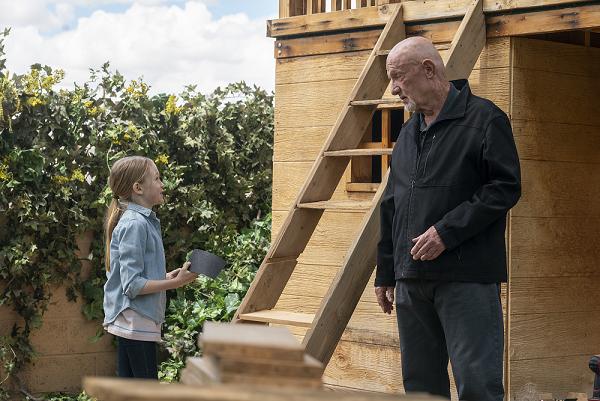
 

Better Call Saul “50% Off” (S5E02)

“In the end, you’re going to hurt everyone around you. You can’t help it so stop apologizing and accept it. Embrace it. Frankly, I’d have more respect for you if you did.” – Chuck

Jimmy can pull himself back from going too far as Saul all he wants but Saul is already setting events into motion from the limits he will continue to push. The episode opens with two skells taking Saul’s ‘50% off’ per legal representation offer as an excuse to go on a wave of frenetic, doped-out crime sprees in the hope to score more drugs. For these addicts, reward trumps risk and they are just two potential clients wrecking havoc out in the world out of who knows how many but their actions will reverberate exponentially. Within the hour, Saul has already caused a direct chain of events that leads him right back into the stammering guy we knew back when he was on his knees before Tuco and Nacho in the desert.  The broken gnome from the cold open and Saul’s tossed ice cream cone at the end perfectly illustrate this correlation.

But is Jimmy the same person from the last time Nacho saw him? Saul has always possessed fear in the face of immediate danger as a defense mechanism.  Fear is not a trait that distinguishes Saul from Jimmy.  It’s Saul’s lack of remorse for the consequences of his actions which Jimmy periodically carries with him. I wouldn’t say the Saul we see here is completely free of doubt or regret, but it’s much easier for him to be.  Not only is Chuck not around to judge him, but Chuck is the one who told Jimmy he would have more respect for him if he owned up to his misgivings and skip the show of remorse as a process. Saul is consciously carrying out Chuck’s worst nightmare, sticking it to his deceased brother by wielding his law degree around the courthouse bowels like a chimp with a machine gun. In another way, he’s subconsciously fulfilling Chuck’s challenge to embrace his slippery ways to the fullest, out of the respect he always craved from him.  The elevator hustle he runs on Suzanne (who was already conned into a loss over last season’s Huell dispute) is a brilliant, if not extremely shady way to accelerate their shared case load so he can make room for more clients and in turn, make more money.

In order for Jimmy to embrace himself as a criminal lawyer without regret, he must lose consideration for who gets caught up in his tailspin.  What he will or won’t come to learn, evident of the chaos that ensues in the cold open, is his behavior has a much more expansive blast radius than he can imagine.  If it wasn’t for his 50% offer deal to the addicts, they wouldn’t take that as an invitation to illegally obtain as much fast cash as they can.  If it wasn’t for all that cash, the storm drain as a delivery system wouldn’t be clogged with 10 bags of dope.  This leads to the Krazy 8 (a nickname originating as Ocho Loco for his bad poker play) getting busted by the police trying to fix it, which leads to Lalo coming up with an idea to get Krazy 8 help, which leads Nacho boomeranging right back into Jimmy’s world.

Whether the idea of Jimmy’s crooked services as a lawyer sprang up because of Nacho’s history with him or Saul has made such a splash in the criminal world already to the point where he’s on Lalo’s radar, this is the dangerous road Jimmy/Saul was going to go down one way or another.  Jimmy’s world of building a new name for himself while juggling his relationship with Kim has now begun its convergence with the criminal underworld. Up until now, these two sides of the show have ran mostly parallel.  Only two episodes into season 5, Lalo has already made an influence on Saul Goodman’s life and we know from Breaking Bad that it’s only going to get worse considering Saul feels relieved at gunpoint when it’s verified Walt and Jesse are not associated with this prestigious cartel member.

This is what makes Kim and Jimmy’s brief visit at an extravagant open house all the more worrying. On one hand, it gives them a chance to clear the air.  Kim makes her reservations known that scamming her clients at any measure or time is not okay with her and Jimmy humbly accepts that.  Jimmy is also honest about the slip-up he made in giving a 50% off deal per legal representation of non-violent felonies and vows he’ll never make that mistake again.  He reassures her that nothing too bad will happen from it, which we know is a reassurance he can’t be certain of and in whole isn’t true, but Kim takes this in good stride nonetheless.

Kim and Jimmy have their differences but their relationship in this moment feels more hopeful after coming to an understanding with one another. Kim even entertains the prospect of them living in such a big house together and is playful and laughing when soaking a fully clothed Jimmy in the shower.  This is all fine and dandy considering we want these two characters to be happy with one another and maybe possibly share a future, but we know Saul’s trajectory doesn’t end in rainbows and sunshine.  As Better Call Saul’s two main worlds begin to merge amidst the brink of war between Gus and Lalo, how soon is it before Kim is crossing paths with any of these dangerous figures? How might they influence her absence from Breaking Bad?

What’s great about these storylines melding together is that I’m just as invested in the fate of Nacho as I am in Kim’s.  I’ve never felt such a heightened sense of dread and despair since Breaking Bad’s final season compared to when Nacho is abducted from his bed by Gus’ crew and made to sit and watch as Gus holds a figurative scythe over his father’s head. It’s a shocking mood shift that really makes you feel like this is the end for Nacho’s father but Gus uses this as fearful motivation to get Nacho to gain Lalo’s trust.  As much as I fear for Nacho and his father, I’m also curious about Gus because we learn in Breaking Bad that he does not believe fear to be an effective motivator.  He tells this to Mike in regards to Walt’s motivation to work for him after Mike proposes the idea of filling Walt in about Tuco’s cousins and how working for Gus would protect him.  What happens with Nacho that makes Gus stray (as best he can) from this method?

As of right now, instilling fear in Nacho is working. He’s willing to risk everything for his father by jumping across rooftops to snatch the remaining product from the stash house as it’s being raided by police.  All of this is to gain Lalo’s trust as Gus demanded, but how long can Nacho thrust himself upon grenades before Lalo takes advantage and pushes him to the limit? Lalo has a great amount of respect for Nacho now, but what does that mean coming from this charming lunatic? This is the same guy who treated Nacho’s prison-defying action stunt like it was a scene from a movie, chuckling at the idea that he’s about to get caught.  Nacho gained his trust but as a soldier willing to nearly fall on his sword for the operation.  Something eventually is going to give here and now that Saul Goodman is becoming more involved, what transpires next remains wildly unpredictable and won’t be pretty.

There’s also a matter of Krazy 8, who’s become more and more of a character as this series progresses.  Saul likely has been recruited to represent him but from what we know from the former show, I have to ask the question. Is this the bust (taking place in 2004) where Hank Schrader flips him into an informant? Hank reports to his task force in Breaking Bad’s season 1 episode “Cancer Man”, “Way smarter than your average cheese eater.  I turned him out when he was street level.”  Gomez then goes on to say that Krazy 8 would snake out all the small town dealers he informed on in order to climb the ranks, so we can suspect this was an ongoing process. Enough to last roughly four years though until the Breaking Bad timeline begins? It’s hard to say, but if this is the start of Krazy 8 getting flipped and Saul is the one who’s representing him, doesn’t that complicate things? Perhaps I’m getting ahead of myself here but there’s a gap of story that’s again, curious.  Honestly, I don’t think I’ve had so many questions going into a season but it being the penultimate, it’s a good sign to how increasingly compelling this show is becoming all across the board as a prequel.

Meanwhile, Mike wakes up hungover after a rough night, being clearly is in a bad place after murdering a good man.  It’s one thing to see Mike lose his cool at work and not be on good terms with Gus, but it’s another when his double life bleeds into the one that matters most.  This episode is about worlds colliding, being cleverly titled “50% Off” not just because of Saul’s deal with potential clients, but because Better Call Saul has been more or less two shows in one where until now has striven to be neatly divided.  That’s never fully the case though in a universe that’s established how every piece and action undertaken matters.  Eventually your decision in one world will dictate what happens in the other and for Mike, this leads to him scolding Kaylee after a significant nerve is hit when she inquires about her dad’s death.  Specifically about his job as a cop and how “the bad guys got him” is what sets Mike off.

We’ve seen Mike’s nerve struck in last season’s “Talk” when Stacey shares how she’s starting to feel guilty for not thinking about her late husband Matty for stretches of time, but taking it out on Kaylee is much more upsetting.  I don’t blame Mike for his grief, but this is the dark, descending spiral he’s been on for a while now and it’s now catching up to him.  I’m sure he feels regret for lashing out on his grand-daughter so we can only hope he can come to terms with what he’s done and the life he’s chosen for himself before the people he truly cares about suffer for it.  It’s a strange thing to hope for since it basically means Mike has to become more cold-blooded and numb to the horrible things he’ll continue to directly or indirectly take part in.

One last thing. It looks like Howard wants to set an appointment for lunch with Saul.  Bob Odenkirk gives a superb, subtle performance when confronted here by allowing a shred of Jimmy McGill’s guilt to peek through the Saul Goodman mask.  Jimmy doesn’t know what Howard wants but from his perspective, Howard was always more in Chuck’s camp and any judgement Chuck carried may have been passed on to his grieving law partner.  We have to remember that the last interaction between these two before Chuck passed was Jimmy trying to get Howard to settle on the Sandpiper case followed by Howard coldly calling him out as transparent and pathetic for trying to hustle the money.

Howard has obviously dialed that resentment back ever since Chuck’s death, but them being on the same page with one another is still something I wouldn’t say is completely warm.  On the other hand, Jimmy did give Howard a tough love speech to help save HHM which might have worked, while also donating $23,000 to Howard for Chuck’s memorial reading room.  Imagine if Howard wants to hire Saul at HHM? That would be crazy, but whatever the case is, Howard associating with Saul Goodman at this point is just another future of a character we’re going to have to add to the list to be concerned about.

Some tidbits:

  • Kim barely has any closet space for herself seeing as it’s packed with Saul Goodman suits and attire.  A sad metaphor for her misplacement in this relationship and the not-so-bright future of her sticking around.
  • Jimmy apparently has 45 clients to juggle.  The scene where he’s ironing his clothes while trying to talk on his cell phone was a perfect way to introduce Saul Goodman’s hands-free bluetooth ear-piece. The physical transformation is almost complete, save for the combed over mullet.

Better Call Saul “Magic Man” (S5E01)

Ladies and gents.  Boys and girls. Welcome back! Season 5’s “Magic Man” is chock full of whimsy, wonder, and absolute unnerving tension.  Tradition dictates we start with Gene’s post-Breaking Bad content which has become more extensive and anxiety-filled than any previous season premiere cold open yet.  That’s saying a lot.  Better Call Saul, like its predecessor, never back-pedals when stressing the urgent significance of its cliff-hangers.  When Gene found himself being heavily studied through a taxi cab driver’s rear-view mirror last season, we had every right to feel panicked.  Season premieres had long established Gene’s usual paranoia of being found out, but the obviously suspicious taxi cab driver donning an Albuquerque Isotopes air freshener set off too many alarm bells for it to amount to nothing this far into the story.

We’re lulled into a false sense of security as we watch Gene keep his police radio scanner running to ensure this stranger didn’t make any police reports of a Saul Goodman sighting.  Gene even makes a carefully placed call to a Cinnabon employee from an out of town payphone slyly inquiring if anybody in particular had been asking for him.  After some time has passed, all seems well and Gene returns to work but lo and behold, the cabbie shows up revealing himself as Jeff, a long-time fan who seems to get off on having famous passengers.  There’s many uncomfortable moments in this show but this scene ranks among the highest as Jeff is not only speaking for the first time directly at Gene, but he’s rude, intrusive, and smarmy.  These are qualities I would never have attributed to what little we could make of him during last season, which is what helps drive this suspension of disbelief that maybe this isn’t the same guy…but it is.  Jeff interrogating Gene in such a gross, depriving manner and forcing him to recite Saul’s key catch phrase while asserting a sense of power over knowing who he is, is nothing short of infuriating.

Ironically, this is the same mall bench that got Gene in this predicament to begin with in season 3’s “Mabel” when Saul’s primal urge to blurt “Get a lawyer!” to a detained shop-lifter causes his own physical collapse.  This leads to the hospital visit he would later take the cab home from.  As Captain Bauer from the Air Force base told Jimmy in that very same season 3 opener, “the wheel is going to turn”, meaning consequences are coming for the life direction Jimmy chooses.  By beckoning the shop-lifter to get a lawyer, despite compromising his low profile in the vicinity of law enforcement, Gene reaffirms who he is.  Not someone who can stay in hiding.  Not Gene.  Gene is not in his D.N.A.  He’s Saul Goodman.  A problem solver at any cost.

This theme is reignited when Gene is faced with an easy, if not expensive reset button from Ed the Disappearer.  Gene’s got diamonds of all things in his band aid box (a keepsake introduced since the series premiere) which very well may pay for the steep expenses for him to “poof” and relocate, but then it hits him…  As the title of the episode suggests, Saul Goodman is the magic man and that’s who he is and always was. “Welcome to My World” by Dean Martin is the song that plays when Gene opens the Cinnabon for business and that’s the tune he’s skipping to.  He no longer plans to run from where he’s ended up or whatever any higher power has in store for him.  As the song goes:

“I’ll be waiting here…

With my arms unfurled…

Waiting here for you…

Welcome to my world…”

This is a pure character-driven decision for Saul to stay in Omaha and handle the cab driver and his silent pal on his own.  It’s very different from Walter White not being able to disappear himself and his family because of a plot-based obstacle like Skyler having no choice but to give away Walt’s money to Ted Beneke.  It’s also a much different direction than New Hampshire’s “Live Free or Die” motto that drove Walt back to New Mexico in the Breaking Bad finale.  Nebraska’s State motto is “Equality before the Law” which is something Saul has always valued in his own twisted way going all the way back to his desire to be Chuck’s peer, no matter how many corners he needed to cut to achieve that.  Saul Goodman will not allow anyone to ever hold any sense of power over him.  It’s all an equal playing field and he’ll bend the law in any way he sees fit to fight and win.

But does he actually value equality anymore? Jimmy McGill certainly did, but Saul Goodman seems to revel in rising above all else.  This entire episode, Saul refers to his own future clientele as assholes and morons.  It’s less about helping the less fortunate like Kim has been doing as a public defender and more about running a manipulative game on them for his own gain.  What’s most unsettling though is how Saul seems to lump the entire world in with the rest of his clients, garnering no consideration for anyone but himself, including Kim.  The world is one big mark for him to con and everyone in it is just another trick in his bag.  Kim, as Saul states, is someone who can pull him back when he’s gone too far and that’s what he values in their relationship.  She’s a necessity but that has nothing to do with what Kim values.  When Jimmy asks “Is there some angle I’m not seeing here?” while sharing direct eye contact, she can’t bring herself to protest.  This is how the beginning of a break-up happens when one partner simply allows the other to blow the relationship up.  If Jimmy can’t see why his behavior and outlook is destructive, then their separation will become justified.  There’s no use in explaining why she feels hurt if it conflicts with his newfound world view that’s taking off like a runaway freight train.

Kim enters this season in a haze, emerging into focus after a dizzying array of passing colors, representative of the magic puff of smoke cast by Saul Goodman, but also representative of her mixed bag of emotions.  Kim, like many people, is not somebody who’s alright being made vulnerable.  She definitely is not okay with being used the way she was and continues to be. Towards the end, Saul parades around the courthouse lobby using his impressionable film crew to solicit his sleazy services and uses fellow public defender Bill Oakley like a prop in a skit.  Kim, unbeknownst to Saul, is used like another prop against her will as he practically usurps Kim’s role as a legitimate legal practitioner, nearly demanding they run a scam on her clients to prevent them from wanting to take their case to trial.  Talking Saul Goodman down to the point where she has to lose her cool in order to pull him back to Earth is a humiliating, difficult position to be put in.  How long does she have to keep being his tether to reality before he breaks her? Is this the role Kim wants to serve as in their relationship?

Kim is left nearly defeated in the face of her clients and to save face she uses that to play up the scam Saul impelled upon her.  It’s easier to go along than admitting her own defeat which is a dangerous road to go down.  Saul essentially forces Kim’s hand in a similar way Jeff the cab driver forces Gene’s.  Both are left on a bench, strung along like a puppet against their will by someone who is attributed to the same adjectives: rude, intrusive and smarmy.  The question is, does Kim do the equivalent of disappearing by ending the relationship or is she going to own up to the man she’s been involved with for all this time? Better yet, who is she to be with him in the first place?

In last season’s “Wiedersehen” Jimmy called Kim out for not being completely in his camp. It’s an ongoing contradiction that’s owed to an identity crisis and that in turn is due to not coming into full terms with the world she’s paved for herself.  What is Kim’s world? Is it to be Saul Goodman’s undying, supportive partner to the point where it leads to her potential demise or is her life better off elsewhere? Does her mysterious past life growing up along the Kansas/Nebraska border dictate any of the decisions that lead her here from the beginning? This is the overwhelming crossroad she’s left with as she catches her breath in the stairwell because now she has to commit to one choice or another.  After all they have been through it’s hard to leave him (fallacy of sunk costs), but staying with him is absolutely dangerous and she already senses that. There is so many questions to consider here and season 5 seems determined to explore them.

Speaking of impending doom, the parallel story of Better Call Saul finds Lalo delving deeper into the Werner Ziegler conspiracy now that he knows the man has been reported dead.  His suspicions that something odd is afoot leads him to investigate the cocaine supply after Nacho steers him towards what might be more of a non-issue.  Nacho is a middle man double agent who is just trying to keep the peace until he can forge a plan to get him and his father out of the country.  However, Lalo being put on the trail of drugs leads him right back to Gus’ chicken farm after learning that some of the cocaine had been replaced with meth, a product Don Eladio has long frowned upon and takes offense at the very idea of its inclusion into the operation without his say.

Lalo meets with Gus under Juan Bolsa’s moderation and Gus apologizes for the secrets he’s kept from them, delivering a cover story for the super lab explaining that construction is underway for a chicken chiller.  Lalo knows enough details through his private sleuthing that this cover story is all smoke and mirrors.  He knows about a south wall and of poured concrete which seems to have nothing to do with the project Gus is showing them. He’s also smart enough to know that Mike is shadier than the supervisor of a legitimate construction crew after surveilling Mike in season 4’s finale.  Juan might have bought Gus’ phony story but for Lalo, the game has just begun and he lets Gus know that with a wink and smile.

What’s most interesting about this development is that when Juan firmly reassures Lalo that Gus is strictly business who holds no grudge over his partner Max’s death, Lalo responds, “Like what happened in Santiago? Was that business too?”.  Back when Max was killed in the flashback in Breaking Bad’s “Hermanos”, Max pleaded with Don Eladio, vouching that Gus is a good man who saved him from the Santiago slums. Can we expect more of Gus’ past in Chile to actually be explored? Or will it remain a mystery ala the contents of the suitcase in Pulp Fiction? How does Lalo factor into Santiago? Did Gus do something that affected him or more importantly the Salamanca family as a whole? Is there a deeper reason to Hector’s hatred of Gus?  We know Hector has held a grudge against Gus going all the way back to the flashback in Breaking Bad’s “One Minute” where Hector referred to the Chicken Man smugly as a “Big Generalissimo” who shouldn’t be trusted.  There’s many theories that surround Gus, including the likeliness that he was connected to the Pinochet Regime.  Something that would make him high ranking enough for Don Eladio to spare his life.  Regardless, this shows just how ingrained Lalo is in this universe. At this point, I’m becoming more interested in him as a character than as a plot device to converge the show’s storylines.

Meanwhile, Mike relieves the Germans of their operation, stressing the consequences in the event they break their agreement of never speaking a word of what they helped build.  They are completely aware that Werner’s death was no accident but are united to stay cooperative.  I imagine if one person breaks their word, the entire crew are under the threat of said consequence.  That said, Kai, who was presented as last season’s red herring/bad apple, surprisingly tries to comfort Mike that what he had to do was for the best and that in the end, Werner was a good man, but soft.  These condolences only get under Mike’s skin and he does to Kai what I believe he was waiting to do all of last season and knocks him sideways.  Being told that Werner is soft as an excuse for his disposal is the last thing Mike wants to hear because it once again brings up the memory of his own son’s death.  It’s something he had to shake to even go through with Werner’s murder but alas, it will always haunt him.  The next guy called upon to go home by Mike is Casper who tells Mike exactly what he would prefer his son to be remembered as: “He was worth 50 of you.”  This only cuts into Mike deeper and for a rare occasion we see Mike get put in his place.

Mike and Gus, as expected, are not on good terms.  For one, Mike is insulted by Gus’ corporate way of resolving the Werner situation with the wife.  She’s compensated for her grief as if you can put a dollar value on such a thing.  For Gus, throwing money at the problem of Werner’s wife and throwing money at Mike to be on retainer for doing nothing is an evil Mike won’t stand for.  His own moral reservations over what he’s done is just collateral damage in an operation that’s bigger than him. There’s a bridge of story here that still has yet to be naturally told to bring Mike around to his involvement with Gus.  Like Kim, he’s going to have figure out his place in the world he’s lent himself to.  The only person in this entire hour who seems to be completely comfortable with themselves right now is Saul Goodman and that’s not too reassuring.  Season 5’s premiere is carrying the show forward into extremely chaotic territory.  At some point, something horrible is going to have to give.  The anticipation of whatever that may be is scary.

Also, rest in peace Robert Forster.

It was good to see him play the role of Ed the Disappearer one last time.


Better Call Saul “Winner” (S4E10)

In a question of unbridled sincerity, season four’s swan song “Winner” kicks off with a flashback showcasing a time when newly appointed attorney Jimmy McGill felt the strongest affection and admiration for his brother, Chuck, who swears him in before the New Mexico Bar Association. It’s a moment so strong to the extent where even Chuck (harbored grudges aside) is enamored likewise by this feeling.  The brotherly bond runs deep as Jimmy celebrates becoming a lawyer with his karaoke rendition of Abba’s “The Winner Takes it All”, which a reluctant Chuck is pulled on stage to sing alongside him.  It’s the one time in the show where Chuck is happily swept up in Jimmy’s blissful aurora and embraces him most fondly and publicly.

Even if he doesn’t want to admit it, Chuck is proud of Jimmy here and that becomes most prevalent when the two are alone crashing together for the night where there’s nobody around to potentially pretend for.  Despite politely brushing off Jimmy’s drunken ramblings that the two McGill brothers have become equals, Chuck immediately snaps out of any fixed umbrage when Jimmy begins to sing the song once again.  Jimmy cherishes this sweet, rare moment of connection to his brother and Chuck chimes in because he too appreciates its value.  It’s the most pure on-screen display of the unconditional love, however complicated, that exists between them.

Jimmy ironically carries this memory with him throughout the episode, even when forcing himself to appear sad over Chuck’s death to any on-lookers from the law community.  The paradoxical magic of Abba’s “The Winner Takes it All” brought these brothers close but the lyrics actually prophesize their bleak, underlying conflict and serves as a theme to the regrets Jimmy feels for allowing himself to love and honor Chuck for the better part of his life.  Jimmy tried his best to play by the rules in order to recapture that rare feeling of making Chuck proud and in the end, it crushed him.  As he sees it, his past mistakes forever doomed him as an irredeemable screw-up to those who hold the keys to the castle of opportunity and that’s how it’s always been.  He realizes the world will define you by your actions and reaffirms the only way to counter that is by cutting corners, which has always been his instinct.

Jimmy relays this line of thinking to a young Kristy Esposito, a rejected finalist for HHM’s memorial scholarship who he served on the board to vote for.  As her only supporter, Jimmy sympathized with her, being a kid who was once caught shop-lifting and seemed to have worked hard to correct a mistake she very well may have learned from.  Jimmy pleads to her, “Remember, the winner takes it all,” after telling her to bend the rules and rise above the people who are dead-set to shut her out.  It’s this “the end justifies the means” form of advice he wishes he could have given to his younger self before the McGill war came to a head.  As Kim made clear last episode, Jimmy is always down and there’s no more appropriate place but HHM’s depressing basement parking lot for him to have an uncontrolled breakdown over this epiphany.  What might sting most is he could have been on the figurative fiftieth floor instead if he had not felt such a burning desire to make Chuck happy.  Through his suppressed grief, this is the feeling that is so real and sincere, it finally comes pouring out with a devastating performance by Bob Odenkirk.

At the end of the cold open, Jimmy stresses the natural order of symmetry in a drunken tangent to Chuck (two eyes, two hands, two nipples, etc.).  It’s all nonsense babbling but it paints a clear picture of Jimmy’s world-view assumption that he’s entitled to just as much as Chuck for achieving the bare minimum solely because of his idealized fantasy that they’re two brothers of the same profession.  Jimmy even suggests adding another M to HHM in order to restore symmetry (HHMM).  I don’t think Jimmy necessarily believes he’s as smart as his brother or as accomplished, but despite Chuck living life on the straight and narrow, he has a strong, resilient backbone.  He has just as much of a backbone to zig left as Jimmy has to zag right and that’s something their father, from Jimmy’s perspective, sorely lacked.  Jimmy has always felt superior to his father but Chuck built a life for himself in tribute to how good his father was and I think this always amazed Jimmy.  The thought of taking something seen as pathetic and turning it into gold is one thing, but for Chuck to reject Jimmy in a harsher manner than Jimmy rejected his father could be seen as the greatest slap in the face.

The tension in Jimmy’s story lies in the anticipation that he’s going to finally confront his brother’s death and allow himself to truly feel his feelings to appear sincere at his appealed reinstatement hearing.  Faking tears over Chuck’s headstone while literally sobbing the words “boo-hoo” sets itself up for the question: How does Jimmy go from a laughable circus act to a moment of sincere, cathartic introspection by the end of the hour?  We already witness him have an honest breakdown in HHM’s basement parking lot so we know he’s capable of feeling something. Chuck’s farewell letter being taken out like it’s the magic key to recapturing those emotions for a genuinely sound testimony clues us in on the plan, but we already know the letter had no effect on him the first time around.  Maybe now it will work though, especially since all the hard, expensive ground-work of Jimmy’s grieving narrative has been spread to everyone in Chuck’s professional orbit? At the hearing, Jimmy barely reads a few sentences before stopping himself and it’s here where we realize this off-the-cuff deviation from the plan is the true road to salvation.

In my review of the previous episode “Wiedersehen”, I mentioned how this season seemed to be building towards Jimmy confronting his brother’s death, while the parallel story of Mike is about unburdening himself from the death of his son.  The separate journeys undertaken by these two characters tend to mirror each other whether through similarities or opposition. Symmetry, if you will.  It seemed pretty cut and dry that Jimmy had to tap into his honest opinion on Chuck in order to truly emote. The speech he gives to the board is in the essence of a moving Don Draper pitch.  It’s humble, it’s spontaneous, and we know as long-time viewers, that he’s speaking the hard truth.  When we see Kim (someone who arguably knows Jimmy more than anyone) getting misty-eyed, we know this is real.  It’s real, it’s real, it’s real, and then Jimmy pulls down the curtain in celebration of winning everyone over and reveals it’s all bullshit, duping all of us, including Kim.  Was it an act though? Or did he somehow allow himself to feel something real and in turn used it for deception? That’s the scariest part of this ending being that he can go so far down the emotional well which he’s avoided all season and come back up with it meaning nothing to himself.

Kim is left stranded speechless as she, for once, is on the receiving end of Jimmy’s scheme.  A scheme that he pulled out of thin air without realizing the effect it would have on anyone in the vicinity, regardless if it’s someone he supposedly cares about.  How can Kim trust Jimmy after that?  She’s worked scams with him before and is aware of his magic and trickery but this ending reveals a darker side to him where even the real and sincere is just another tool in his bag of tricks.  Everything real that Kim feels for Jimmy or believes Jimmy feels for her is potentially worthless now.  If he could dismissively turn the grief for his dead brother into a lottery ticket, then what chance does Kim have to mean anything beyond another card in his deck? How can she make heads or tails of what he actually values?  Throughout the entire series, fans have been waiting for the introduction to Saul, and while this ending is the greatest push forward and the journey is not over, we’re getting what we’ve been anticipating in the most heart-wrenching, tragic way.  The final turn where Jimmy pivots his entire body in one eerie motion before exclaiming “It’s S’all good man!” is the most earned, ‘twist-of-the-knife’ conclusion to date.

The outcome to Mike’s story goes as predicted by my last write-up, but that by no means takes anything away from the magnitude of where it leaves us. The episode spirals into a mad hunt for Werner while also juggling a cat-and-mouse game between Lalo and Mike for reasons that remain curiously odd.  Lalo, who serves as a mystery as to exactly how he’ll play into the show’s endgame, surveils Gus’ operation in this time of crisis.  He has no knowledge of the construction of the super lab or why everyone is scrambling all over town, but he’s getting closer to learning something, even it means ramming cars in private parking lots or killing the TravelWire clerk who helped give Mike information on Werner’s possible whereabouts.  The Lalo portion of the B story is very chaotic, as it should be, but it’s ultimately setting the stage for what story developments we can expect from season 5.  In the end, we know Lalo is going to play an important enough role to the point where it will bleed into Saul Goodman’s world and possibly signify Nacho’s demise, or who knows, even Kim’s. Gus told Juan Bolsa in the beginning of the season, “someone will make a move on the Salamanca family and that will bring war, which brings chaos, which brings the D.E.A.” We’ll stay tuned.

As I mentioned, story execution still needed to play its part in properly landing the conclusion of Mike being forced to deal with Werner Ziegler. In my “Coushatta” write-up, I speculated how Mike would possibly pledge allegiance to Gus if he is put in the position to take Werner out and this episode helps us understand that, somewhat.  Throughout the hour, an angry, concerned Gus stays silent.  The story becomes less about forcing Mike to do anything and more of Mike feeling responsible for this colossal hiccup which he knows he should have been on top of.  Better Call Saul revels most in character-driven outcomes more than plot-driven.  The characters dig their own graves and that’s a factor that helps Mike realize that Gus’ operation is too great for him to have a conflict of morality over what happens to Werner.

Werner knew what he signed up for and knew his decision to leave was foolish, but he was blinded by his undying urge to simply see his wife again.  If the lives we lead lend themselves to a story, then our decisions (again, reflective of where the world places us) will eventually write ourselves into inescapable corners. Unfortunately, all the pieces were in the right place for Werner to meet his end even if he didn’t fully understand the game he was playing until it was too late.  Just the same, all the pieces were in the right place for Mike to deliver what Werner had coming to him and that’s because of Mike’s own choices throughout the season.  The final scene with Mike and Werner is handled so beautifully in the way Mike grants Werner a chance to save his wife while Werner sees Mike’s troubled situation clearly for what it is, and unlike Walter White’s frantic, compromising refusal to accept his own fate, Werner not only accepts but selflessly makes it easier for Mike to do what he has to do.  Werner is the sweetest man to ever fall victim directly to Mike and this definitely shakes Mike to his core.

There are so many stars visible in New Mexico.  I will walk out there…to get a better look…” – Werner

It’s official now.  Mike has now become everything he’s always hated.  He’s now killed a good man and turned an unsuspecting wife into a widow.  It’s what happened to his son and the good samaritan Hector killed back when Mike hijacked the delivery truck in season 2.  He blamed himself quite heavily for both of these tragedies, so we can expect season 5 will open with Mike in an extremely dark place.  The thing is, with a fuming Gus left inside the most expensive hole in the ground West of the Mississippi, does Mike being indebted to this problem become more urgent than his own internal reservations over what he’s done?  Will he bury this incident deeper in the archives of all the terrible things he’s had to do and become more hardened?  We know he’s more cold-blooded about killing in Breaking Bad than where he is now, but this murder is much different than the violent goons who were in the cartel game.  I think there’s still a significant amount of story left to tell here because Gus and Mike are not on the even ground we’re accustomed to in the other show.  Mike is going to have to seriously figure himself out after this.

Other things to note:

  • No Nacho this episode.  He just becomes absorbed into the Gus/Lalo war that’s starting to brew.  There’s something unsettling about that.  At a certain point, Nacho’s secret plan of escaping to Canada with his father under false identities is going to become a reality.  Gus and Lalo pulling him back and forth to do their bidding is eventually not going to end well.
  • I was hoping the show would check back in on Howard and I’m happy that he’s looking healthier and that HHM is recovering from its setbacks. Earlier on in my write-ups, I compared Howard to Werner in that they were both willing to see the hurdles ahead of them for what they are.  Howard got his hands dirty and seeked therapy over Chuck’s death, while Werner approached the construction of the superlab as the dangerous and difficult operation that it was.  I’m glad for Howard’s sake that symmetry went for opposition here in terms of where they ended up.
  • Mike choosing the gum in his glove box over the gun (wordplay) lead to another clever way to shake Lalo from tailing him.  Better Call Saul never runs out of brilliant ideas for these characters to get themselves out of a jam.  It’s too bad there was nothing as inspired in the glove box to relieve Werner from his fateful predicament.

That’s a wrap on season 4! It was another great one.


El Camino: A Breaking Bad Movie Review

“Everything I think I know is just static on the radio…”

Could I have gone on happily with my life without ever having seen El Camino: A Breaking Bad Movie? Considering how tightly wrapped up Breaking Bad was as a series, of course that’s true.  I’m always grateful for what’s already been given. But does a film focusing on Jesse Pinkman’s quest for freedom following Breaking Bad’s finale a necessary venture regardless?  Most people would tell you no, yet they liked or loved the movie anyway (as did I), but I’m going to go out on a limb and argue a solid “kind of, maybe, yeah” in regard to its necessity.

A little under a year ago when the film was first announced, I went into great depth listing my concerns for what I feel would help it succeed from a critical standpoint.  Avoiding these pitfalls doesn’t guarantee a brilliant movie, but it’s a template I thought would help nonetheless.  Long story, short, the bullet points were as follows:

  • No Walter White (Unless the story dictates).
  • The events of Breaking Bad do not need to be explained.
  • Preserve the Breaking Bad finale’s small shred of open-endedness.
  • The film needs to prove its worth.
  • Remember, Jesse’s in the driver’s seat now.  Not shotgun.

Going forward with this film, conceptually, was a monumental task.  The opening frame, being a signature wide and closed shot of Jesse staring across a lake at a mountain, isn’t just symbolic to the giant hurdle Jesse would have to overcome in achieving the fresh start he desires (or the chance to put things right, which Mike firmly tells him is the one thing he can never do).  It’s also a self-aware, metaphorical nod to the difficult task ahead for Vince Gilligan to land Jesse’s proper conclusion without it stepping on the toes of the former series or proving to be a pointless endeavor.  And when I say proper conclusion, I don’t mean a love letter to the fans for what they might giddily hope to see, but something of value that Vince sincerely felt he should tell.  In the series finale, Jesse’s story ended on an ambiguously conclusive note which was fitting, but it was just a note.  Not a conclusion for a character who earned the role of co-lead (regardless if the show was intended primarily for Walt) and who proved to be just as essential in light of the pawn/plot device he becomes towards the end of the show’s run in larger service to Walt’s story.  Jesse Pinkman has always been a special appendage to Breaking Bad’s journey and El Camino sets out to remind you that.

There’s no question Jesse will carry physical and psychic wounds brought on by Walt’s destructive actions for the better part of his life, so whether or not Walt made an appearance here, his spiritual presence would have inevitably hung over El Camino in a dark, ominous manner.  That said, I’m glad we got little snippets of context through news reports of who this Walter White guy is without taking any focus away from Jesse Pinkman’s present trauma and conflict.  This is what helped give Walter White’s unceremonious turn down the hotel hallway so much dramatic weight.  Here, in a flashback scene taking place directly after being stranded in the desert from season 2’s “4 Days Out”, Walter couldn’t appear any more harmless or vulnerable.  It’s a moment in the series when both characters were sort of at peace that this might be their final cook together, pending confirmation that Walt’s lung cancer hasn’t grown significantly worse.  For standalone movie-goers, this is the same Mr. White who’s been dubbed a drug kingpin and has apparently claimed the lives of many people, stirring up a nationwide manhunt.  The same guy being one who gives such poignant, albeit hopeful advice that Jesse is lucky to have so much time to do something special with his life.

This is shortly followed after a scene where Walt puts Jesse’s intelligence on the spot, trying to measure what he’s capable of and what the future may hold for him.  Walt, being as self-involved as he is, completely forgets Jesse achieved his high school diploma (“Yo you were standing right on the stage when they handed it to me”).  Jesse shows a hint of interest towards maybe pursuing a field in sports medicine if he were to attend college and Walt entertains that idea for about a nanosecond before suggesting a business degree.  For all of Walter White’s intellectual superiority and experience, you have to wonder what the hell does he even really know after all the terrible choices he made towards the end? Who is he to tell Jesse what to do with his life?

It’s at this point where I need to direct your attention to the film’s ending song (“Static on the Radio” by Jim White, featuring Aimee Mann) because I feel it’s immensely important to understanding the film’s underlying themes and use of flashbacks throughout.  It’s dreary, wondrous, and simply beautiful. Listen carefully:

Please also read this superbly written and concise analysis of “Static on the Radio’s” meaning I came across from music blog series The Delete Bin (credit to Rob Jones, thedeletebin.com) as it definitely gave me a deeper appreciation for the song’s use in the film.  Keep in mind, this was written long before the movie. 

Let’s consider the lyrics:

And I know (it’s a sin putting words in the mouths of the dead)
And I know (it’s a crime to weave your wishes into what they said)
And I know (only fools venture where them spirits tread)
‘Cause I know (every word, every sound bouncing ’round my head)

You might have noticed that in every flashback scene, Jesse is recalling some nugget of advice a now deceased character (or spirit) has relayed to him:

  • Mike says, “Only you can decide what’s best for you. Not him (Walter), not me,” while also finishing the scene stating, based from his experience, that ‘putting things right’ is the one thing you can never do.
  • Todd says, “You know Uncle Jack says…life’s what you make it.”
  • Walt says, “You’re really lucky, you know that?.  You didn’t have to wait your whole life to do something special.”
  • Jane says “I’ve gone where the universe takes me my whole life.  It’s better to make those decisions yourself.”

And I know (the blind will sometimes lead the blind)
And I know (through shadowlands and troubled times)
And I know (forsaking love, we see it’s a sign)
And I know (of truths forever hid behind)

Regardless of who’s behind the phrase and whether or not any person in question has affected Jesse’s life in a positive or negative way, it’s all generally good, if not vague words of wisdom that can be spun in any direction he sees fit.  It all sounds nice and it may be exactly what Jesse needs to hear but is life not more complex?  Some of the people sharing their well-intended existential philosophy may be hypocritical, deluded, complicit, morally ambiguous (more good or evil), or complacent when you stop to think what road their motto of philosophy may or may not have lead them.  It goes to show that people in our lives can be just as lost as Jesse, you, or I when it comes to finding the right way to live.  Words to live by can be interpreted in a number of ways so it’s up to you for how to make it work.

‘Cause I know (dreams are for those who are asleep in bed)
And I know (it’s a sin putting words in the mouths of the dead)
‘Cause I know (for all my ruminations I can’t change a thing)
Still I hope (there’s others out there who are listening)

In the beginning of El Camino, Mike plants the idea for Jesse to take up a life in Alaska which is what he ends up striving towards.  He also tells Jesse he won’t be able to correct the unfortunate events of the past and yet, by the end of the film, Jesse still feels the need to make an effort for young Brock, an innocent victim of Jesse’s circumstance, by sending a letter most likely explaining and apologizing for why Brock’s mother was senselessly murdered by Jesse’s captors.  By doing this, Jesse can at least hope to bring some peace to Brock if the boy is willing to hear it.  It doesn’t correct what’s already happened but it’s the best Jesse can possibly hope to do for him.

For me, what I got out of this film is you are who you are and you’ve done what you’ve done.  If you can accept and take responsibility for that, you can begin to move forward, be better, and be content with the life you’ve paved for yourself since the beginning and until the end.  Anyone who crosses your path telling you how life could be spent otherwise is something you need to pick and choose for yourself as you grow.  Because life is not as certain or simple as any fortune cookie slice of philosophy could suggest.  In the end, everyone’s figuring it out as they get older and everything you think you know may very well slip away.  It’s all static on the radio.  You pick up and apply what you know in incremental drips and drabs and the best you can hope for is what good may come from truly acknowledging life’s complexities as you live the life you call your own.

I actually liked that El Camino (spanish for ‘the road’ or ‘the way’) was more meditative, not just in a spiritual sense but mechanically because that’s exactly what made Breaking Bad so special to begin with (something the series finale did away with by having Walt randomly appear in places and magically get things done). The in-between minutiae of conflict that you rarely witness in crime stories is what this show, for the better part of its run, absolutely excelled at. It’s that compelling ‘one foot forward and two steps back’ form of storytelling that drew me to the show in the first place. By the end of Breaking Bad, Walt became such a despicable character and was so far gone from any shred of sympathy, that the show conceptually stripped that narrative structure away from the viewer. Long are the days of taking three episodes to dispose of bodies, an entire episode trying to get the RV’s battery to start, or spending an entire season figuring out how to get rid of Gus.  A Breaking Bad film about the more empathetic Jesse makes sense to bring that methodical pace back, especially considering he’s a character who (while proven to hold his own and has grown to be sharper as an individual) doesn’t possess the same magic, intelligence and bravado that Walt had.

Any other film about a fugitive on the run would have gone all in for the non-stop, action-packed thrill of the lead character racing against the odds to outrun the cops, much like El Camino seemed to be hinting at before Skinny Pete and Badger’s video game fakeout. This film offers that tension but it’s more cleverly derived from its smaller, character-driven moments. Figuring out a plan and saying goodbye to Skinny Pete and Badger instead of bolting out of there is more real and believable to me than the film serving as some vicarious ‘what would I really be doing in this situation’ type of story.  Like sure, not shaving would be an ideal way to come off unrecognizable to law enforcement, but Jesse is his own person with his own exclusive experiences and trauma.

The same goes for Jesse deciding to give Todd back his gun for the chance to have some pepperoni pizza and beer rather than a possible escape. It’s especially a more psychological, helpless moment like that which makes Jesse Pinkman a uniquely interesting and deserving character to follow. Spending a significant chunk of the film with Jesse poking around in Todd’s apartment (the last space he wants to occupy) and further exploring the hell that Jesse had to go through rather than glossing over it with mere implications of his torture and imprisonment helps make the road to renewing his sense of self and humanity all the more richer. I like that there are so many unexpected, trivial hang-ups that prevent Jesse from moving on as simply as getting in a car and driving away.  Instead he has to work backwards, wrack his brain over where Todd may have hid his money, and stew in the memories of his enslavement like a bad nightmare while simultaneously proceeding onward like a dream where it takes forever to get to where you want to go (if reached at all before waking).

*By the way, Jesse Plemons’ performance as Todd was a striking reminder of how twisted and unconventional he was at playing the sociopathic villain in those final two years.  He’s definitely one of the more redeeming additions to the series so late into its life cycle and I’m happy Vince seized the opportunity to give him a significant role for him to shine with here.

Another familiar touchstone of Breaking Bad is celebrated thusly with the script’s daring ability to write itself into corners and then write itself out in the most earned, uncompromised manner.  Old Joe wiping the El Camino off the face of the planet (free of charge) would have been just as convenient (ala deus ex machina) as the coincidence of the LoJack’s tracking system being initiated the moment Joe was scanning the car.  The feds are homing in fast but Skinny Pete saves the day with an inspired, improvised plan B by having Badger drive Skinny’s car to the Mexico border while keeping the El Camino right where it is.  It’s the perfect diversion while Jesse drives North in Badger’s car.  Much better than the lazier direction of a typical hollywood car chase.

The creme de la creme though is later when Jesse is literally backed into a corner as two “police officers” search Todd’s apartment with Jesse inside and he’s forced to crawl his way out, guns drawn.  He actually disarms the first man before getting into a stand-off with the other who was wise enough to know his partner was in trouble.  Every beat of this is a master class in tension-building because before you know it, Jesse’s laying flat on his stomach, presumably in custody, but (twist) the two men are actually associates of Uncle Jack who are just looking to score some loot from the recently deceased Todd.  Even with Jesse utterly defenseless, the story finds a natural way to proceed without resorting to any cop-outs.  Seriously, so much good comes from Vince Gilligan deciding to devote Todd’s apartment as the film’s centerpiece. It’s something I initially felt uneasy about but from the moment it was creepily established in flashbacks to its urgent destruction through staple Breaking Bad-esque montage, and then the pay-off with Neil and Casey serving as antagonists, it accomplishes so much with unwavering execution.

The inclusion of new characters like Neil Kandy, the welder who fixed the meth lab’s dog chain with full complicity to Jesse’s imprisonment and torture, and his spoiled partner Casey, is an audacious, yet beneficial decision on Vince’s part because 1) Jesse needed to overcome some baddies (Walt can’t be the complete “hero” to Jesse’s story) and 2) the catharsis he achieved in the series finale to withdraw from the drama brought on by his own demons (revenge, ridding the world of every evil) needed to be challenged.  The scene of Jesse being forced to run back and forth so Kenny and Neil can bet on whether the chain will break is one of the most unthinkably upsetting moments in the film.  It sets the viewer up to be furious and wanting to see these characters ripped limb from limb.  They don’t just serve as additional antagonists, but they stand in for Uncle Jack’s crew (Jesse strolling in their place of business mirroring Walt’s final act of violence at the neo-nazi clubhouse) and it helps that they remain a colorful, distinguished duo in their own right.

All of that said, Jesse’s approach to the situation is different.  He respectfully asks for a measly $1,800 and to never be seen again, being a modest request from someone who allowed Neil to take the majority of Todd’s money. Neil, if circumstances played out differently, seems prepared to shruggingly grant this plea.  However, he’s been drinking, just snorted cocaine, and feels on top of the world after partying with hookers.  Add to the fact that Casey is buzzing in his ear incessantly about how emasculating it is that Neil even gave Pinkman a cut to begin with.  I believe to the fullest extent that if given the money, Jesse would have been the bigger man to walk out of there and close the door on those goons forever.  Neil, on the other hand, represents the Jesse Pinkman of the past in some ways by giving in to the manipulations of his partner, the needless urge to initiate a shootout (“Half Measures” ending), and the naivety in what it means to feel on top.

I don’t think Neil wants a gunfight but is too weak not to upset his buddies.  Jesse doesn’t need to prove something so petty and childish, but if he’s going to get money from anywhere, it’s not going to be from his parents or some random robbery, it’s going to be from those he knows will deserve what they get, worse comes to worse.  Vince Gilligan intelligently places the audience’s (and most definitely Jesse’s) itching desire to do away with Neil as a last resort insurance plan, but it’s not something Jesse feels needs to happen.  This is who Jesse Pinkman is.  Not willing to kill, but capable when he has to.

As an audience who has followed this character for an entire series, we may have a bias in terms of the strong empathy we hold for Jesse.  He’s committed terrible acts but we understand on an emotional level, beat by beat, what drove him to those acts, and we especially know how much punishment he’s faced for it, if not by the world, then by himself.  In El Camino, the universe is indifferent to his torment as it always was.  When Ed, the disappearer turns Jesse away for coming up short with his payment, Jesse tries to win him over with sympathy of his life story (most specifically, events of recent), in which Ed responds by saying he should try his ability to pull on heartstrings with the police if he’s so certain it will work on him.  Ed says, “From where I sit, you made your own luck. As did your former partner.  As did your lawyer.”

This is what I was hoping the film would address because it goes back to what everyone in the flashbacks were more or less expressing.  Life is what you make it.  You need to face the life you’ve made for yourself and stop running from it.  It’s why Jesse endearingly tells his parents they aren’t to blame and they did the best they could with him because this isn’t so much a getaway movie as it is a story of self-realization as one catches and owns up to their current state of being.  Whereas Walt’s motto was twisted in that of New Hampshire’s “Live Free or Die”, Jesse is in pursuit for Alaska’s “The Last Frontier”, his last chance to come to terms with himself and the choices he’s made.

I found El Camino to be a more profound and effective stopping place for Breaking Bad’s story than that of “Felina” as it has left me reflecting on it just as intensely but with its more methodical return to form.  After “Ozymandias”, I didn’t go into El Camino expecting it to be anything more climactic than simply giving Jesse a proper conclusion as his story dwindles down and yet, it was an enjoyable movie on its own which I welcome into the series canon with open arms.  It checked off everything I hoped it would avoid and accomplish.  It used Walter White appropriately, it didn’t feel pre-occupied with explaining anything (Walter White’s death confirmation is more to sting the fan theorists and to witness Jesse’s reaction), and it used Jesse’s catharsis of valuing freedom and peace of mind as a sly source of tension.  It also leaves the appropriate questions from “Felina” still up in the air.  Following up on where Skyler, Marie, or Junior are at with incoming “donated” money or court proceedings would have been too much information that would have defeated the point that Walt left his family in ruins regardless of what he thinks he might have made up for.  Plus, that’s not a part of Jesse’s world to begin with.

The most important question though is still preserved.  Is Jesse (or Mr. Driscoll) really okay now that he’s driving towards an isolated future?  He’s definitely better off than the manic, screaming state we saw him at the end of the series and beginning of this film, but the juxtaposed, quiet drive into Haines, Alaska makes you wonder.  Will he continue to appreciate his slice of secluded freedom or will he increasingly crack under the pressure of solitude like Gene seems to with every Better Call Saul opener?  I like to think he’ll be better at it, but like the mountain in the opening shot or the entire range surrounded him when burying Todd’s housekeeper, is life not full of conflicting and problematic hurdles to overcome?  The final image of mountains is a gorgeous wide shot showing them snow-capped just beyond the trees, suggesting that external conflict and inner-struggle will exist as long as you live.  Life’s complexities can either overwhelm or stand as a majesty to marvel at and cherish.  You can take it for what you will.